
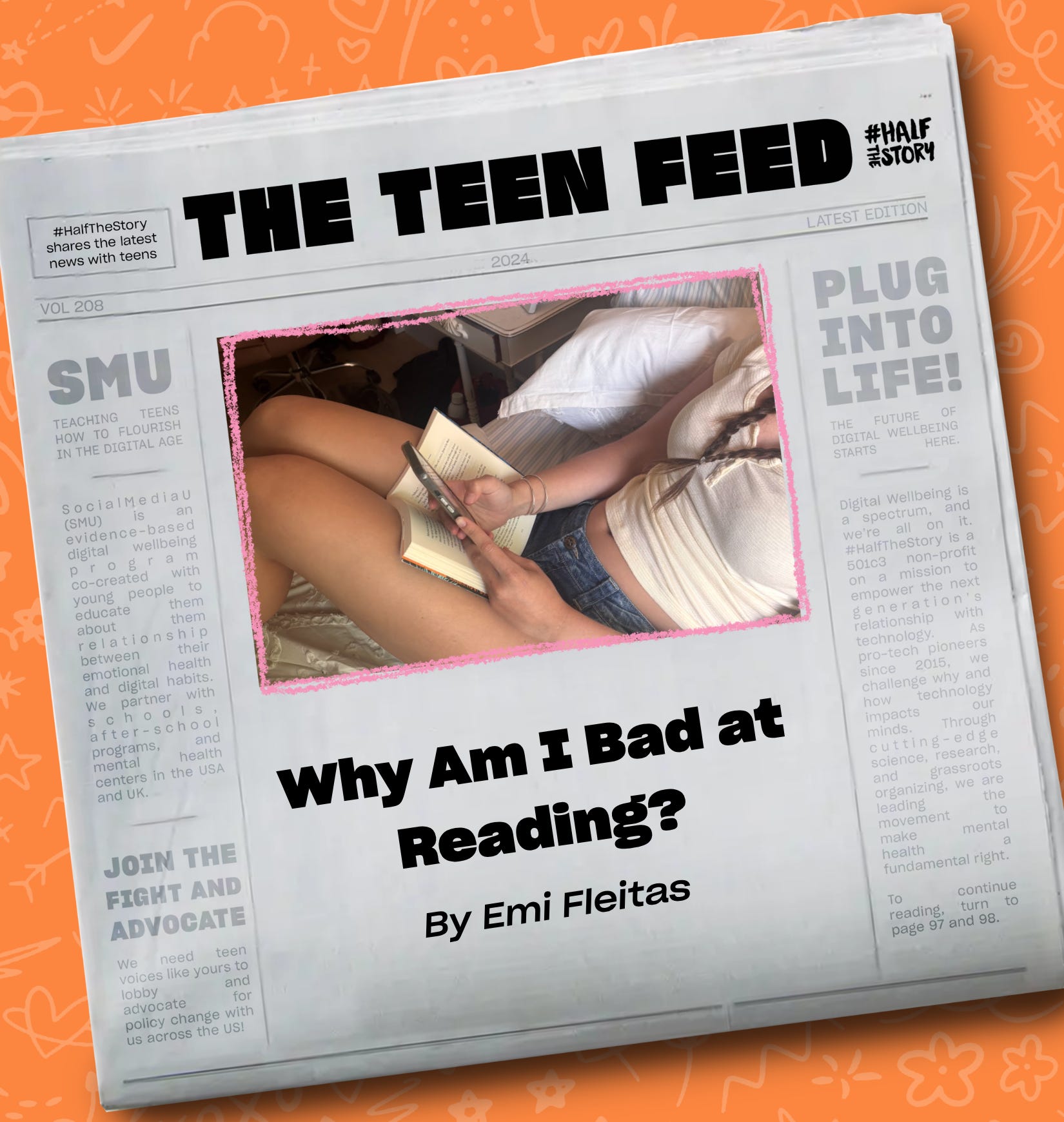
Why Am I Bad At Reading?
Has anybody ever told you that they are “bad at reading”, or maybe you’ve thought this about yourself?

Has anybody ever told you that they are “bad at reading”, or maybe you’ve thought this about yourself?
Picture this; you open a book everybody loves, you’re a few lines in, maybe even a few chapters, and you couldn’t be more bored. For some reason, this seems to happen with any book you pick up, of any genre, of any size, by any author. If you have felt this way, it may feel as if you are “bad at reading”.
I am here to tell you that you are not alone.
You’re probably not surprised when I say that literacy rates in America have dropped significantly due to social media. As stated by USA Reads, America currently has the highest rate of illiterate adults in about 155 years.
Social media shortens our attention spans by giving us videos and photos that are fast paced, designed to give our brains hits of dopamine. Research by Dr. Gloria Mark from the University of California, Irvine found that attention spans today are on average 47 seconds, a significant decline from 150 seconds in 2004. The same goes for constant notifications, seeing what our friends are doing, and checking how many likes or comments we have. These short, sweet, interactive dopamine triggers are designed to keep us constantly engaged.
According to the American Psychological Association about 20% of teenagers read every day, while a whopping 80% use social media daily. This statistic is not only shocking, but highly concerning. As social media use increases for adolescents and adults, literacy rates fall in suit. The material we read on social media is nowhere near as rigorous as our brains require to be proficient in reading. To have a rich vocabulary, proper understanding of grammar and good use of context clues, reading books–both fiction and nonfiction–are good for the development of our brains, according to the Harvard Medical School. Think of it as this; reading is a protein that helps build the muscle of our brain.
Friends have told me they are “bad at reading” because they can’t stay focused and don’t understand the diction or syntax used. When I looked into why so many teenagers nowadays feel they are “bad readers”, I found that their reading issues weren’t due to the books, but due to their brain’s ability to actually read. As a society, we typically think of people that are “poor readers” as either dyslexic, or illiterate due to language barriers. However, people can be below the recommended reading level, and still function normally throughout their daily lives.
The ways in which a lack of reading shows up in someone’s daily life, are most commonly seen through an inability to understand context clues, spell or sound out words, and comprehend how grammar changes the meaning of a sentence. Although these might not be considered “important” when we are young, as we grow older these skills will be crucial for achieving a good income, and being an active member of society.
Nerdish, along with doctor recommendations, found that reading just 15 to 30 minutes a day can improve someone’s cognitive abilities, and brian function. However, Nerdish also stated that different people require different levels of support and time to develop the critical thinking and attention skills necessary to become good readers.
My message is this: you do not need to delete social media and never allow yourself to doom scroll, but instead, truly look at what social media is doing to your attention span and your reading abilities. For those 30 minutes you usually scroll or watch a show before bed, try swapping that out with a book, or in the morning reach for a book before you reach for your phone. These small changes can have such a vast impact on the brain’s development, that I hope you give it a try.
Best case scenario, you find a love for reading you didn’t know you had.