

When Everything Is For Clicks, Nothing Feels Sacred
Imagine this: you’re on your couch, phone in your hand, doing that mindless scroll you don’t even remember starting.

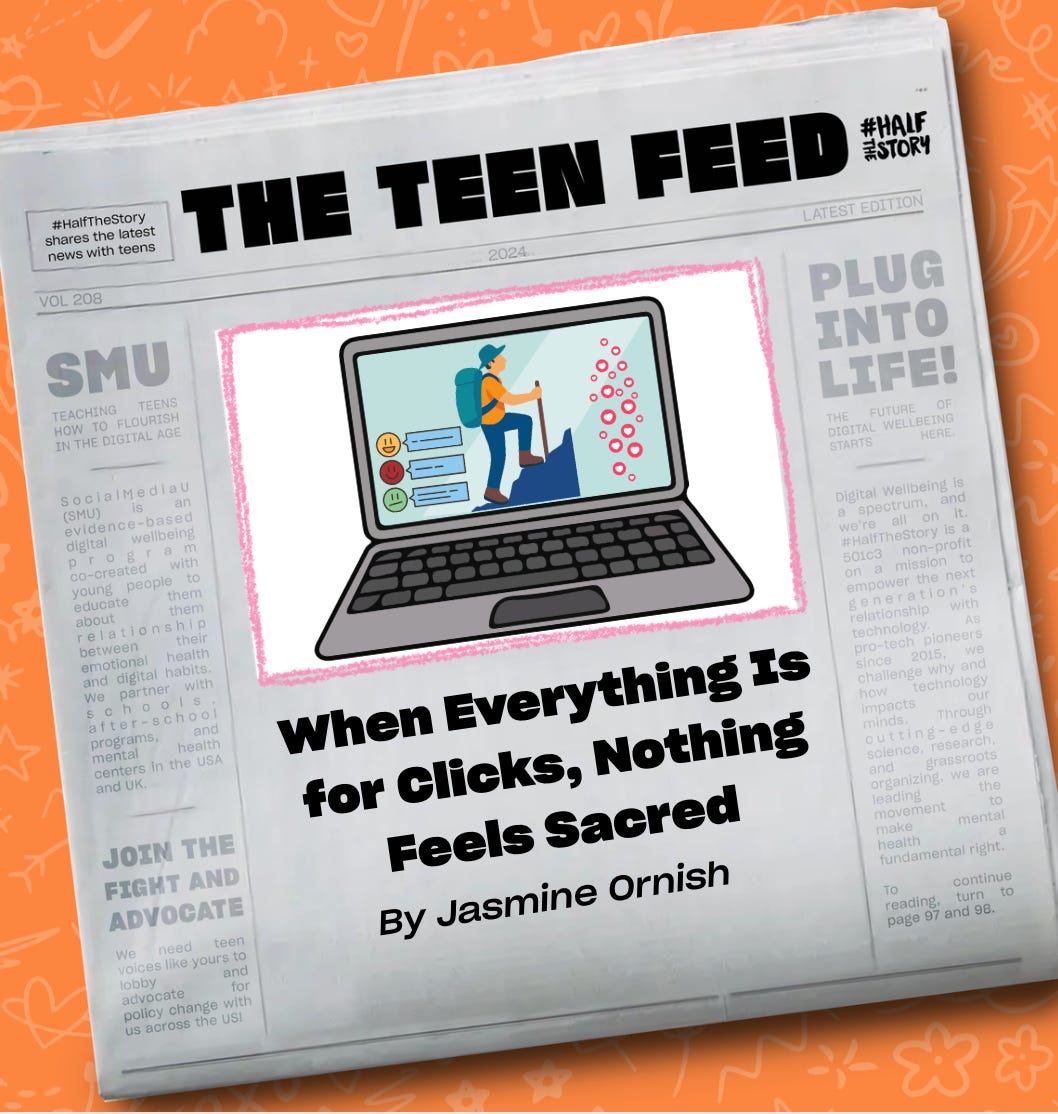
Imagine this: you’re on your couch, phone in your hand, doing that mindless scroll you don’t even remember starting. Your thumb keeps moving like it’s on autopilot. And then you land on a video that instantly drops you onto the view from the top of Mount Everest.
The view people train for. Suffer for. Risk their bodies for. The kind of moment that is supposed to be the payoff for years of effort, fear, and becoming. And you see it in two clicks. No cold air in your lungs. No trembling legs. No months of discipline. No doubt. No growth. No story. Just the ending.
I watched a video about a guy who went through this exact moment, and you could tell it hit him like a real epiphany, like something in his nervous system woke up. He said seeing Everest like that made him want to delete Instagram right then. What moved him wasn’t just the view, it was the realization of what he skipped. He wasn’t supposed to be at the peak yet.
Not because he didn’t “deserve” beauty in some moral way. But because the thing that makes the peak feel sacred is the climb. The struggle is the meaning. The struggle is what turns a view into awe. And that’s when it clicked for me, too. Because suddenly I realized how many “peaks” I consume every day that I didn’t climb for either.
Maybe it’s not Everest. But it’s always somebody’s Everest: their acceptance letter, their dream trip, their relationship, their talent, their glow-up, their “I made it” moment. And we absorb it the same way we absorb everything online. Fast. Back to back. With no time for our bodies to catch up with what our eyes just saw.
That pace isn’t just a feeling. It reflects how much time many teens are actually spending in these environments. According to the CDC, about 50% of teens ages 12 to 17 have four or more hours of daily screen time outside of schoolwork. Researchers and youth health organizations have increasingly raised concerns that this level of screen exposure can shape how teens experience comparison, stress, and emotional well-being.
Social media does something quiet but powerful. It starts convincing your brain that life is supposed to feel like the highlight reel. It starts rewriting your standards without asking permission. So you look at your own life and start feeling behind.
I know I’m not the only one who feels this. I’ve heard friends describe that strange, hollow feeling after scrolling, when you should feel entertained or inspired, but somehow just feel smaller. That tension shows up more broadly, too. A Pew Research Center report found that many teens feel conflicted about their screen use, with a significant share saying they spend too much time on their phones even while continuing to use them frequently.
The reality is that as a teen, we live in public even when we’re alone. We’re constantly surrounded by other people’s endings. So the middle feels embarrassing. The middle feels like proof you’re behind. The middle feels like something you should hide. But the middle is where life actually happens.
The middle is where you learn how to be resilient. Where you build actual skill. Where you develop a real identity that isn’t based on approval. The phone can’t show you that part in a satisfying way. It’s too slow. Too quiet. Too “un-postable”. So it disappears online. And then we start forgetting it’s normal.
That’s why that video got under my skin. Because I saw myself in it. This made me realize that digital well-being is not only about screen time. It’s not just “use your phone less.” It’s about protecting something deeper: your relationship to effort, your patience with the process, and your ability to stay inside your own life without constantly measuring it against someone else’s peak.
At #HalfTheStory, we talk a lot about prioritizing wellbeing over engagement, and this is one of the clearest examples I’ve felt of what that actually looks like.
Because engagement loves the peak. Wellbeing honors the climb.
So the next time you catch yourself spiraling after watching someone else’s “Everest,” ask yourself: Am I watching this to feel inspired, or am I watching this to escape my own process?
Because once you see the pattern, you can start choosing differently. You can let other people’s peaks be what they are without turning them into a verdict on your life. Your life is not failing just because it’s in the middle. The middle is the part that makes the peak mean something. The struggle is not proof that you’re behind. It’s proof that you’re doing it for real.
What do you think it would look like to protect the climb, not just chase the peak?