

Nextdoor isn’t so neighborly…
so how can we build online connections with our in-person communities?

A few months ago, I walked into the kitchen to find my mom staring at her phone, perplexed. She was scrolling through the Nextdoor app, trying to follow a tense argument about windows. Yes, windows. One neighbor was warning everyone to shut their windows to keep out bears while others were fiercely advocating for their right to do whatever they wanted. My mom and I both looked at each other, questioning just how neighborly Nextdoor is.
Nextdoor, a social networking app for neighborhoods, was originally described by board member Bill Gurley in 2011 as “different from other social networking sites because it was built from the ground up to help neighbors come together in a trusted environment.” My family consults the app often, with my parents usually aiming to understand how to deal with a local issue and my sister and I trying to reach out to neighbors to start a local tutoring business. The truth is, I really do want to build connections with my neighbors. However, when I’m on Nextdoor, I’m often overloaded by bickering between neighbors, information that doesn’t even apply to my area, and a tense digital environment. And, I’m not alone.
When I searched for others’ feelings towards the platform I came across comments about how, for some, Nextdoor has made them actively avoid their neighbors. This avoidance could be due to aspects like Nextdoor’s moderation model, which relies on volunteers who can apply bias to the process, and the concept of anonymity which has allowed for heated arguments over minor grievances, (like the window situation), without consequences. Also, the platform has an overwhelming number of advertisements, which has been seemingly ineffective for both local businesses who see minimal return from their paid ads and users annoyed by excessive advertisements on their feed.
However, the good news is people are starting to become aware of the importance of digital, connective spaces with neighbors. New Public, an organization reimagining digital conversations, has started designing Roundabout as an alternative to digital platforms like Facebook and Nextdoor. The platform’s aim is to connect individuals with immediate neighbors, creating communities of less than 50 people, where individuals can easily access information regarding various local events.
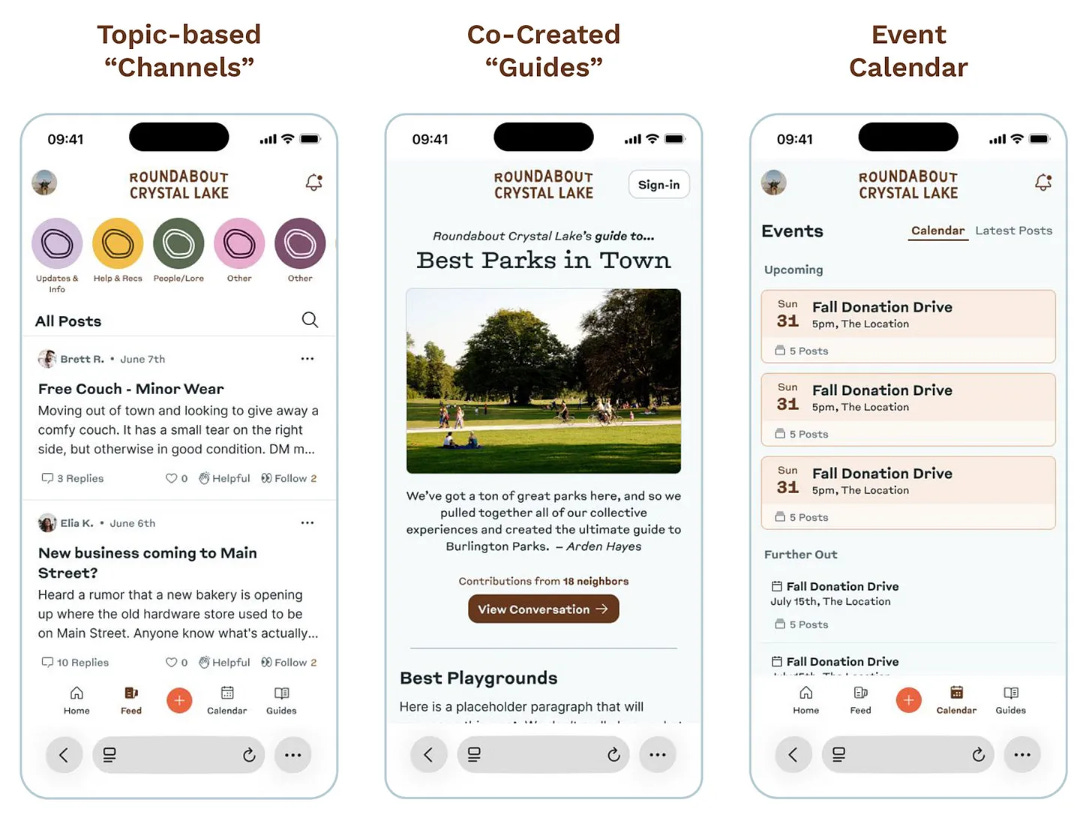
Mock-ups of Roundabout found on New_Public’s Substack
When New Public illustrated the thought-process behind their new platform, the team posed questions that touch on the fundamentals of digital spaces, like “Could part of the revenue generated go towards embedding local journalists to investigate the community’s most pressing questions? Could a local digital space link up with tools like Civic Sunlight that summarize long town hall meetings into bullet point takeaways? Could we make it easy for stewards to aggregate announcements and upcoming events from websites, newsletters, or other social feeds of local community organizations?”
Though Roundabout is still in its early stages, it will be interesting to see if this space has any impacts on our connection with our neighborhood communities. And, this conversation does highlight something important: healthy online spaces are key to healthy IRL communities! I mean, how much better would our communities be if neighbors notified each other about fun and impactful local events or sent out messages relating to safety? By immersing ourselves in digital platforms that emphasize our values, communities and support-systems can thrive!